
website translator plugin
If you’re getting bored of all these technology predictions, here are ten ‘predictions of predictions’ to break the monotony from the folks at CAST Software.

#1 – Robots will replace humans

Source – Robot manufacturers and robotics professors looking for funding
Our Prediction – The entire human population will soon be living a luxurious life of leisure as-yet-unrevealed robots, wholly unlike the unconvincing wire-strewn devices we currently see, will so remove any reason to get out of bed each day.
Automotive manufacturers and others will indeed further automate existing uses for machines. The task of integrating the various layers of software required to perform even such basic tasks in a ‘smart way’ will be harder than ever. On the brightside, software development will also be taken over by robots and the promise of standardised, interoperable and compliance systems may have a chance after all.

#2 – Your parents discuss the ’Internet of Everything’

Source – Telcos and Big Data vendors
Our Prediction – The irrational urge to connect every domestic and industrial appliance to the internet becomes unstoppable. More new uses will be found to link sensors, smartphones and corporate systems.
Integration of multiple devices and interfaces will cause more security holes because the app security industry hasn’t yet figured out that real security problems happen because of poor interfaces at the whole-system level

#3 – Malware, Hack and Phishing will empty your bank accounts

Source – IT Security Vendors
Our Prediction – The cyber security hype cycle will continue to churn as companies keep throwing money at cyber training, tools and consulting. Yet still after billions spent over the past 10 years, several name brands will experience significant breaches. Customers will be up in arms, experts will continue to be mystified and CEOs will head for the door.
Those who continue to ignore the underlying structural integrity of their software will once again make headlines.

#4 – Software will be measurable (as if..)

Source – IT departments
Our Prediction – The dark art of code development will soon become, just a little, more like a science. Just as many other advances in technology the ability to improve quality will spur more innovation.
At this heavenly time of year, it is perhaps relevant to remember, the father of quality himself, W Edward Deming, once said “”In God we trust, all others bring data”. The combination of automated function points, a recognised set of global standards and tools to visualise progress on quality will finally provide some certainty to the effort and the costs in developing software, both in-house and by outsourcers.

#5 – Big Data and analytics will be even…Bigger

Source – Big Data vendors (again)
Our Prediction – Even cleverer insights are possible, yet arguably, not necessarily needed, thanks to super clever software that analyses every micro moment of every smartphone and web session. The data of the future will be so, er, Big.
As data pools increase the data hype will decrease. The vast amount of Big Data created will finally focus attention on real issues, like application health.

#6 – DevOps becomes Dev-Oops

Source – Storage and Data Management vendors
Our Prediction – DevOps, the bastard son of Developers and Operations, has become the ‘Jack of All Trades’ who is ‘Master of None’. The losers in this, the guys down in the basement, with the still-spinning disks, make a bid to reclaim their ‘rightful place’.
The de-skilling of IT operations and smaller teams, will produce worse code more quickly, which will result in IT systems which are fragile, not just agile.

#7 – 3D Printers Print 3D Printers

Source – 3D Printer manufacturers
Our Prediction – Just like PCs, iPhones and microwaves, every household will soon have its very own 3D printer. Reliability, safety and standards will be overrun by convenience and speed as the Hacker Manufacturer cripples the consumer electrons sector, displacing millions jobs worldwide as Mum and Dad print whatever they need rather than buying it online. “Hey Mum can you print me a new iPhone? This one is cracked.”

#8 – The Cloud Turns to Smog

Source – Cloud-based enterprise software vendors
Our Prediction – Now that the rush to the cloud is mainstream, clear choice to cloudify everything will get a bit murky as legacy apps and brittle architecture fail to hold up to the demands in the cloud.   To solve cloud performance, reliability and stability issues, business will simply move apps back on premise.

#9 – Outsourcing becomes Outcome-based at last

Source – Systems integrators
Our Prediction – Instead of just paying for bodies, clients will start to pay for outcomes, or at least paying by output for software-related work. As automated software measurement becomes a broader reality, application service providers will be able to meter their output and provide a meaningful invoice to clients.

#10 – Tech predictions will cease to exist by 2018

Source – CAST
Our Prediction – As the hype around vendor’s tech predictions gets a bit too cynical, the media will stop publishing these types of articles.
So what?
As has been proven time and again, in many cases, the effects of new innovations are overestimated in the short term and under-estimated in the long term. The common theme CAST sees in all of these predictions, one we thoroughly agree with is that the importance of software and so its quality, will be significantly greater in 2016.
Photo Credit: vinzstudio/Shutterstock


Read more: http://www.itproportal.com/2015/12/28/top-10-tech-predictions-of-predictions-2016/#ixzz3vct8WHaV
If you’re getting bored of all these technology predictions, here are ten ‘predictions of predictions’ to break the monotony from the folks at CAST Software.

#1 – Robots will replace humans

Source – Robot manufacturers and robotics professors looking for funding
Our Prediction – The entire human population will soon be living a luxurious life of leisure as-yet-unrevealed robots, wholly unlike the unconvincing wire-strewn devices we currently see, will so remove any reason to get out of bed each day.
Automotive manufacturers and others will indeed further automate existing uses for machines. The task of integrating the various layers of software required to perform even such basic tasks in a ‘smart way’ will be harder than ever. On the brightside, software development will also be taken over by robots and the promise of standardised, interoperable and compliance systems may have a chance after all.

#2 – Your parents discuss the ’Internet of Everything’

Source – Telcos and Big Data vendors
Our Prediction – The irrational urge to connect every domestic and industrial appliance to the internet becomes unstoppable. More new uses will be found to link sensors, smartphones and corporate systems.
Integration of multiple devices and interfaces will cause more security holes because the app security industry hasn’t yet figured out that real security problems happen because of poor interfaces at the whole-system level

#3 – Malware, Hack and Phishing will empty your bank accounts

Source – IT Security Vendors
Our Prediction – The cyber security hype cycle will continue to churn as companies keep throwing money at cyber training, tools and consulting. Yet still after billions spent over the past 10 years, several name brands will experience significant breaches. Customers will be up in arms, experts will continue to be mystified and CEOs will head for the door.
Those who continue to ignore the underlying structural integrity of their software will once again make headlines.

#4 – Software will be measurable (as if..)

Source – IT departments
Our Prediction – The dark art of code development will soon become, just a little, more like a science. Just as many other advances in technology the ability to improve quality will spur more innovation.
At this heavenly time of year, it is perhaps relevant to remember, the father of quality himself, W Edward Deming, once said “”In God we trust, all others bring data”. The combination of automated function points, a recognised set of global standards and tools to visualise progress on quality will finally provide some certainty to the effort and the costs in developing software, both in-house and by outsourcers.

#5 – Big Data and analytics will be even…Bigger

Source – Big Data vendors (again)
Our Prediction – Even cleverer insights are possible, yet arguably, not necessarily needed, thanks to super clever software that analyses every micro moment of every smartphone and web session. The data of the future will be so, er, Big.
As data pools increase the data hype will decrease. The vast amount of Big Data created will finally focus attention on real issues, like application health.

#6 – DevOps becomes Dev-Oops

Source – Storage and Data Management vendors
Our Prediction – DevOps, the bastard son of Developers and Operations, has become the ‘Jack of All Trades’ who is ‘Master of None’. The losers in this, the guys down in the basement, with the still-spinning disks, make a bid to reclaim their ‘rightful place’.
The de-skilling of IT operations and smaller teams, will produce worse code more quickly, which will result in IT systems which are fragile, not just agile.

#7 – 3D Printers Print 3D Printers

Source – 3D Printer manufacturers
Our Prediction – Just like PCs, iPhones and microwaves, every household will soon have its very own 3D printer. Reliability, safety and standards will be overrun by convenience and speed as the Hacker Manufacturer cripples the consumer electrons sector, displacing millions jobs worldwide as Mum and Dad print whatever they need rather than buying it online. “Hey Mum can you print me a new iPhone? This one is cracked.”

#8 – The Cloud Turns to Smog

Source – Cloud-based enterprise software vendors
Our Prediction – Now that the rush to the cloud is mainstream, clear choice to cloudify everything will get a bit murky as legacy apps and brittle architecture fail to hold up to the demands in the cloud.   To solve cloud performance, reliability and stability issues, business will simply move apps back on premise.

#9 – Outsourcing becomes Outcome-based at last

Source – Systems integrators
Our Prediction – Instead of just paying for bodies, clients will start to pay for outcomes, or at least paying by output for software-related work. As automated software measurement becomes a broader reality, application service providers will be able to meter their output and provide a meaningful invoice to clients.

#10 – Tech predictions will cease to exist by 2018

Source – CAST
Our Prediction – As the hype around vendor’s tech predictions gets a bit too cynical, the media will stop publishing these types of articles.
So what?
As has been proven time and again, in many cases, the effects of new innovations are overestimated in the short term and under-estimated in the long term. The common theme CAST sees in all of these predictions, one we thoroughly agree with is that the importance of software and so its quality, will be significantly greater in 2016.
Photo Credit: vinzstudio/Shutterstock


Read more: http://www.itproportal.com/2015/12/28/top-10-tech-predictions-of-predictions-2016/#ixzz3vct8WHaV

Li-Fi has just been tested in the real world, and it's 100 times faster than Wi-Fi

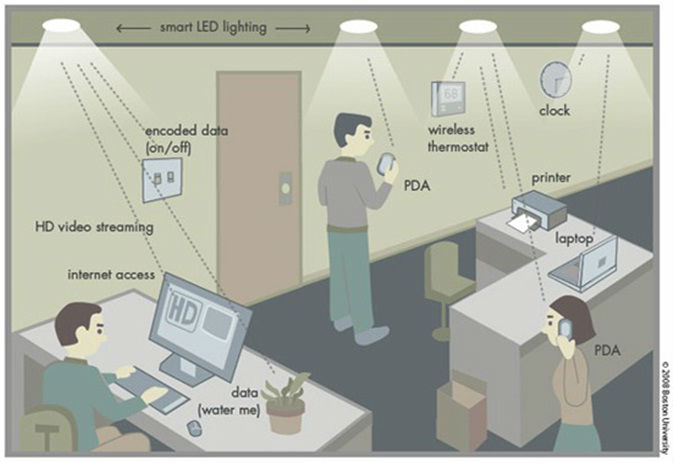
Expect to hear a whole lot more about Li-Fi - a wireless technology that transmits high-speed data using visible light communication (VLC) - in the coming months. With scientists achieving speeds of 224 gigabits per second in the lab using Li-Fi earlier this year, the potential for this technology to change everything about the way we use the Internet is huge.
And now, scientists have taken Li-Fi out of the lab for the first time, trialling it in offices and industrial environments in Tallinn, Estonia, reporting that they can achieve data transmission at 1 GB per second - that's 100 times faster than current average Wi-Fi speeds.

"We are doing a few pilot projects within different industries where we can utilise the VLC (visible light communication) technology," Deepak Solanki, CEO of Estonian tech company, Velmenni, told IBTimes UK. "Currently we have designed a smart lighting solution for an industrial environment where the data communication is done through light. 
We are also doing a pilot project with a private client where we are setting up a Li-Fi network to access the Internet in their office space.” Li-Fi was invented by Harald Haas from the University of Edinburgh, Scotland back in 2011, when he demonstrated for the first time that by flickering the light from a single LED, he could transmit far more data than a cellular tower. Think back to that lab-based record of 224 gigabits per second - that's 18 movies of 1.5 GB each being downloaded every single second.

The technology uses Visible Light Communication (VLC), a medium that uses visible light between 400 and 800 terahertz (THz). It works basically like an incredibly advanced form of Morse code - just like switching a torch on and off according to a certain pattern can relay a secret message, flicking an LED on and off at extreme speeds can be used to write and transmit things in binary code. 

And while you might be worried about how all that flickering in an office environment would drive you crazy, don’t worry - we’re talking LEDs that can be switched on and off at speeds imperceptible to the naked eye. 
The benefits of Li-Fi over Wi-Fi, other than potentially much faster speeds, is that because light cannot pass through walls, it makes it a whole lot more secure, and as Anthony Cuthbertson points out at IBTimes UK, this also means there's less interference between devices.
While Cuthbertson says Li-Fi will probably not completely replace Wi-Fi in the coming decades, the two technologies could be used together to achieve more efficient and secure networks.
Our homes, offices, and industry buildings have already been fitted with infrastructure to provide Wi-Fi, and ripping all of this out to replace it with Li-Fi technology isn’t particularly feasible, so the idea is to retrofit the devices we have right now to work with Li-Fi technology.
Research teams around the world are working on just that. Li-Fi expertsreported for the The Conversation last month that Haas and his team have launched PureLiFi, a company that offers a plug-and-play application for secure wireless Internet access with a capacity of 11.5 MB per second, which is comparable to first generation Wi-Fi. And French tech company Oledcomm is in the process of installing its own Li-Fi technology in local hospitals.
If applications like these and the Velmenni trial in Estonia prove successful, we could achieve the dream outlined by Haas in his 2011 TED talk below - everyone gaining access to the Internet via LED light bulbs in their home.

"All we need to do is fit a small microchip to every potential illumination device and this would then combine two basic functionalities: illumination and wireless data transmission," Haas said. "In the future we will not only have 14 billion light bulbs, we may have 14 billion Li-Fis deployed worldwide for a cleaner, greener, and even brighter future."


source: 
http://www.sciencealert.com/li-fi-tested-in-the-real-world-for-the-first-time-is-100-times-faster-than-wi-fi

Li-Fi has just been tested in the real world, and it's 100 times faster than Wi-Fi

Expect to hear a whole lot more about Li-Fi - a wireless technology that transmits high-speed data using visible light communication (VLC) - in the coming months. With scientists achieving speeds of 224 gigabits per second in the lab using Li-Fi earlier this year, the potential for this technology to change everything about the way we use the Internet is huge.
And now, scientists have taken Li-Fi out of the lab for the first time, trialling it in offices and industrial environments in Tallinn, Estonia, reporting that they can achieve data transmission at 1 GB per second - that's 100 times faster than current average Wi-Fi speeds.

"We are doing a few pilot projects within different industries where we can utilise the VLC (visible light communication) technology," Deepak Solanki, CEO of Estonian tech company, Velmenni, told IBTimes UK. "Currently we have designed a smart lighting solution for an industrial environment where the data communication is done through light. 
We are also doing a pilot project with a private client where we are setting up a Li-Fi network to access the Internet in their office space.” Li-Fi was invented by Harald Haas from the University of Edinburgh, Scotland back in 2011, when he demonstrated for the first time that by flickering the light from a single LED, he could transmit far more data than a cellular tower. Think back to that lab-based record of 224 gigabits per second - that's 18 movies of 1.5 GB each being downloaded every single second.

The technology uses Visible Light Communication (VLC), a medium that uses visible light between 400 and 800 terahertz (THz). It works basically like an incredibly advanced form of Morse code - just like switching a torch on and off according to a certain pattern can relay a secret message, flicking an LED on and off at extreme speeds can be used to write and transmit things in binary code. 

And while you might be worried about how all that flickering in an office environment would drive you crazy, don’t worry - we’re talking LEDs that can be switched on and off at speeds imperceptible to the naked eye. 
The benefits of Li-Fi over Wi-Fi, other than potentially much faster speeds, is that because light cannot pass through walls, it makes it a whole lot more secure, and as Anthony Cuthbertson points out at IBTimes UK, this also means there's less interference between devices.
While Cuthbertson says Li-Fi will probably not completely replace Wi-Fi in the coming decades, the two technologies could be used together to achieve more efficient and secure networks.
Our homes, offices, and industry buildings have already been fitted with infrastructure to provide Wi-Fi, and ripping all of this out to replace it with Li-Fi technology isn’t particularly feasible, so the idea is to retrofit the devices we have right now to work with Li-Fi technology.
Research teams around the world are working on just that. Li-Fi expertsreported for the The Conversation last month that Haas and his team have launched PureLiFi, a company that offers a plug-and-play application for secure wireless Internet access with a capacity of 11.5 MB per second, which is comparable to first generation Wi-Fi. And French tech company Oledcomm is in the process of installing its own Li-Fi technology in local hospitals.
If applications like these and the Velmenni trial in Estonia prove successful, we could achieve the dream outlined by Haas in his 2011 TED talk below - everyone gaining access to the Internet via LED light bulbs in their home.

"All we need to do is fit a small microchip to every potential illumination device and this would then combine two basic functionalities: illumination and wireless data transmission," Haas said. "In the future we will not only have 14 billion light bulbs, we may have 14 billion Li-Fis deployed worldwide for a cleaner, greener, and even brighter future."


source: 
http://www.sciencealert.com/li-fi-tested-in-the-real-world-for-the-first-time-is-100-times-faster-than-wi-fi


NASA's Flight Opportunities Program has selected eight space technology payloads for reduced gravity flights on board specialized aircraft and commercial suborbital reusable launch vehicles (sRLVs). These flights provide a valuable platform to mature cutting-edge technologies, validating feasibility and reducing technical risks and costs before infusion into future space missions. 
Five of the newly selected proposals requested parabolic flights, which involve a flight maneuver that uses a dramatic half-minute drop of the aircraft though the sky to simulate weightlessness. Two proposed projects will fly on sRLVs for testing during longer periods of weightlessness. An additional payload will fly on both platforms.
Selected for parabolic flights on aircraft are:
  • “Zero Gravity Mass Measurement Device Parabolic Flight Test” - John Wetzel, principal investigator, Orbital Technologies Corporation, Madison, Wisconsin
  • “Evaluation of the Biosleeve Gesture Control Interface for Telerobotics in Microgravity” –  Christopher Assad, principal investigator, Jet Propulsion Laboratory, Pasadena, California
  • “Flight Demonstration of a Gravity-Insensitive, Microchannel Membrane Phase Separator” - Weibo Chen, principal investigator,  Creare Inc., Hanover, New Hampshire
  • “PRIME-4.0: Miniaturized and Reusable Asteroid Regolith Microgravity Experiment for Suborbital and Orbital Use” - Josh Colwell, principal investigator, University of Central Florida,  Orlando, Florida
  • “Testing of a Novel IVA (Intra-Vehicular Activity) Space Suit” - Ted Southern, principal investigator, Final Frontier Design, LLC, Brooklyn, New York
  • “Evolved Medical Microgravity Suction Device” - Charles Cuttino, principal investigator, Orbital Medicine, Inc., Midlothian, Virginia
Selected for flights on sRLVs are:
  • “Suborbital Evaluation of an Aqueous Immersion Surgical System for Reduced Gravity” - George Pantalos, principal investigator, University of Louisville, Louisville, Kentucky
  • “Suborbital Particle Aggregation and Collision Experiment-2 (SPACE-2)” - Julie Brisset, principal investigator, University of Central Florida, Orlando, Florida
  • “Evolved Medical Microgravity Suction Device” - Charles Cuttino, principal investigator, Orbital Medicine, Inc., Midlothian, Virginia
           
The selectees’ experiments are expected to take to the skies in 2016 and 2017 on flights with U.S. commercial providers arranged by the proposers. The selected proposals requested parabolic flights from Integrated Spaceflight Services, Inc. and ZeroG Corporation. Suborbital reusable launch vehicle flights were requested from Blue Origin, EXOS Aerospace Systems & Technologies and Virgin Galactic.
This selection was made through the agency’s Space Technology Mission Directorate Research, Development, Demonstration and Infusion (REDDI) announcement adding to more than 160 payloads that NASA has chosen for test flights through the Flight Opportunities Program.
The Flight Opportunities Program seeks to advance space technology to meet future mission needs through flight activities that foster the growth of the U.S. commercial spaceflight industry and workforce. NASA will pay for the integration and flight costs for the selected payloads, and limited funds will be provided for other costs to facilitate the flight readiness of these payloads. The next REDDI Flight Opportunities call for proposals will be released in early 2016.
The Flight Opportunities Program, part of NASA's Space Technology Mission Directorate, is managed at NASA's Armstrong Flight Research Center at Edwards, California.  NASA's Ames Research Center at Moffett Field, California, manages the solicitation and selection of technologies to be tested and demonstrated on commercial flight vehicles. 
For more information on NASA’s Flight Opportunities Program, visit:

NASA's Flight Opportunities Program has selected eight space technology payloads for reduced gravity flights on board specialized aircraft and commercial suborbital reusable launch vehicles (sRLVs). These flights provide a valuable platform to mature cutting-edge technologies, validating feasibility and reducing technical risks and costs before infusion into future space missions. 
Five of the newly selected proposals requested parabolic flights, which involve a flight maneuver that uses a dramatic half-minute drop of the aircraft though the sky to simulate weightlessness. Two proposed projects will fly on sRLVs for testing during longer periods of weightlessness. An additional payload will fly on both platforms.
Selected for parabolic flights on aircraft are:
  • “Zero Gravity Mass Measurement Device Parabolic Flight Test” - John Wetzel, principal investigator, Orbital Technologies Corporation, Madison, Wisconsin
  • “Evaluation of the Biosleeve Gesture Control Interface for Telerobotics in Microgravity” –  Christopher Assad, principal investigator, Jet Propulsion Laboratory, Pasadena, California
  • “Flight Demonstration of a Gravity-Insensitive, Microchannel Membrane Phase Separator” - Weibo Chen, principal investigator,  Creare Inc., Hanover, New Hampshire
  • “PRIME-4.0: Miniaturized and Reusable Asteroid Regolith Microgravity Experiment for Suborbital and Orbital Use” - Josh Colwell, principal investigator, University of Central Florida,  Orlando, Florida
  • “Testing of a Novel IVA (Intra-Vehicular Activity) Space Suit” - Ted Southern, principal investigator, Final Frontier Design, LLC, Brooklyn, New York
  • “Evolved Medical Microgravity Suction Device” - Charles Cuttino, principal investigator, Orbital Medicine, Inc., Midlothian, Virginia
Selected for flights on sRLVs are:
  • “Suborbital Evaluation of an Aqueous Immersion Surgical System for Reduced Gravity” - George Pantalos, principal investigator, University of Louisville, Louisville, Kentucky
  • “Suborbital Particle Aggregation and Collision Experiment-2 (SPACE-2)” - Julie Brisset, principal investigator, University of Central Florida, Orlando, Florida
  • “Evolved Medical Microgravity Suction Device” - Charles Cuttino, principal investigator, Orbital Medicine, Inc., Midlothian, Virginia
           
The selectees’ experiments are expected to take to the skies in 2016 and 2017 on flights with U.S. commercial providers arranged by the proposers. The selected proposals requested parabolic flights from Integrated Spaceflight Services, Inc. and ZeroG Corporation. Suborbital reusable launch vehicle flights were requested from Blue Origin, EXOS Aerospace Systems & Technologies and Virgin Galactic.
This selection was made through the agency’s Space Technology Mission Directorate Research, Development, Demonstration and Infusion (REDDI) announcement adding to more than 160 payloads that NASA has chosen for test flights through the Flight Opportunities Program.
The Flight Opportunities Program seeks to advance space technology to meet future mission needs through flight activities that foster the growth of the U.S. commercial spaceflight industry and workforce. NASA will pay for the integration and flight costs for the selected payloads, and limited funds will be provided for other costs to facilitate the flight readiness of these payloads. The next REDDI Flight Opportunities call for proposals will be released in early 2016.
The Flight Opportunities Program, part of NASA's Space Technology Mission Directorate, is managed at NASA's Armstrong Flight Research Center at Edwards, California.  NASA's Ames Research Center at Moffett Field, California, manages the solicitation and selection of technologies to be tested and demonstrated on commercial flight vehicles. 
For more information on NASA’s Flight Opportunities Program, visit:

EASY TO TRICK GLOBE TATTOO HOME

We just need easytrick application to download in andriod phone para makuha natin ang mac address ng ititricks nating wifi, same lang naman sila ng pang tricks sa Globe basta naka default SSID nya gaya nito PROLiNK_H5004NK_?????. ? - mean the last five digit o number ng MAC. At depende po sa model ng Globe tattoo nyo.


Default password of PROLiNK_H5004NK_????? ay ganito ???WIFI??? Please note: makukuha lang natin sila kung di pa sila nag palit ng default password nila.


Ex. ng default password ng PROLiNK_H5004NK_????? . MAC: 23879Y975123 ang SSID nyan ay ito PROLiNK_H5004NK_75123 then ang default password ito  751WIFI123.

Super tested na po ito. Warning use your own risk.

EASY TO TRICK GLOBE TATTOO HOME

We just need easytrick application to download in andriod phone para makuha natin ang mac address ng ititricks nating wifi, same lang naman sila ng pang tricks sa Globe basta naka default SSID nya gaya nito PROLiNK_H5004NK_?????. ? - mean the last five digit o number ng MAC. At depende po sa model ng Globe tattoo nyo.


Default password of PROLiNK_H5004NK_????? ay ganito ???WIFI??? Please note: makukuha lang natin sila kung di pa sila nag palit ng default password nila.


Ex. ng default password ng PROLiNK_H5004NK_????? . MAC: 23879Y975123 ang SSID nyan ay ito PROLiNK_H5004NK_75123 then ang default password ito  751WIFI123.

Super tested na po ito. Warning use your own risk.

2 years old girl Youngest Rubik's Cube Solver


Rubik's cube is probably one of the most difficult puzzles to solve for the majority because only few can solve it among the millions of people in the world.

If you're able to solve the Rubik's cube, you will surely be treated like a genius in the eyes of many.
While some can solve it, a lot cannot. And maybe some of us has never solve one!
That is why when we came across this viral video below, we were definitely mind blown.
At the age of two, little Hong Yan Chan was able to solve the famous 3D puzzle game in just 70 seconds!
She is beyond amazing because grown ups can't do that and with that age, she just showed how simply it is to solve it.
Hong Yan Chan will probably be hailed as the youngest Rubik's cube solver and she is on her way to become a future Rubik's cube master. 

Watch teh viral video below


2 years old girl Youngest Rubik's Cube Solver


Rubik's cube is probably one of the most difficult puzzles to solve for the majority because only few can solve it among the millions of people in the world.

If you're able to solve the Rubik's cube, you will surely be treated like a genius in the eyes of many.
While some can solve it, a lot cannot. And maybe some of us has never solve one!
That is why when we came across this viral video below, we were definitely mind blown.
At the age of two, little Hong Yan Chan was able to solve the famous 3D puzzle game in just 70 seconds!
She is beyond amazing because grown ups can't do that and with that age, she just showed how simply it is to solve it.
Hong Yan Chan will probably be hailed as the youngest Rubik's cube solver and she is on her way to become a future Rubik's cube master. 

Watch teh viral video below


Does Apple has the right to call their iPhone 6s and 6s Plus the strongest screen any smartphone have? Watch this drop test to see.

After the successful releasing if Apple Company's flagship, the iPhone 6s and iPhone 6s Plus which they claims that it is made of the strongest glass than any other smartphones have. Today we will be having a drop test in both of the units to see if the said to be "strongest glass" is true or only a hoax.
We have here David Rahimi, the one who would do the drop test and also one of the host of phonebuff. At first he put an iPhone 6s on a brick and starts to drop backward it, unbelievably the iPhone 6s didn't have some small scratch but still works and still looks the same.  He also done the same to the iPhone 6s Plus and the same thing had happened.


The next thing he done os the side drop for both iPhone 6s and iPhone 6s Plus, still little scratches on both units but still looks presentable and not that noticeable and the screen is still working on both phones.

The next drop test is the front drop or facing the screen. He drop the iPhone 6s first and it have some cracks on the screen but still working. The next on line is the iPhone 6s Plus but still cracks the screen but still working.
Does Apple have their right to call the iPhone 6s and iPhone 6s Plus the strongest screen that any smartphones have?

Share us your thoughts by leaving some comments below.
PropellerAds